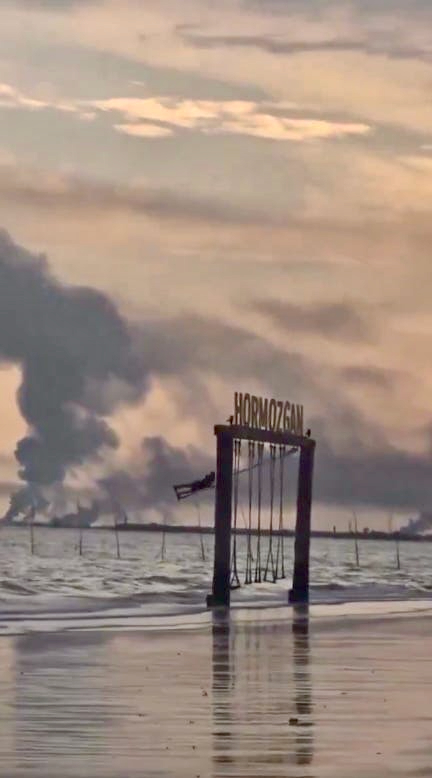

(Iran, April 2026)
As the US President failed to convince anyone (outside of his base) with his April 1 address, a deranged expletive-filled follow up, the genocidal threat to wipe out a 5000-year-old civilisation, a feud with the Pope and now a blockade, let’s add some clarity to the state of play in Iran – and beyond.
I use the word ‘play’ deliberately. Trump acts as if it’s all a reality show; ‘I may bomb it again, just for fun’ (On Kharg Island). ‘We’ll carry on bombing our little hearts out’. Well 165 little hearts were bombed out by a suspected Tomahawk missile in the attack on the Minab school. It’s likely to have been a war crime – and it’s another not to fully investigate. Those ‘stupid rules of engagement’ (Secretary of War Hegseth) may have saved American lives had the daring search and rescue mission for downed airmen failed. The Geneva convention was actually based on the Lieber Code, the first modern rules of engagement, which were conceived during the American Civil War.
The moment every bomb drops, every explosion shatters windows and shakes foundations another tragedy begins – whether in Tehran, Tel Aviv or Beirut. Someone will lose a house, a shop, an arm, a leg – or a friend, a sister or a father. It’s not a game where everything returns to normal once deals are signed and bombs stop raining from the skies. Ask Gazan’s how life is for them after the (continually violated) cease fire agreement.
An attack on Golden Gate bridge would rightly be deemed terrorism – so why isn’t the bombing of an unfinished bridge in a Tehran satellite city? Especially as it was evidently a ‘double tap’ strike – another crime under those stupid rules of engagement. The bridge was actually being built to ease the notorious congestion on the freeway west out of Tehran – making lives just slightly more bearable for the long suffering 10 million Tehranis.
I began this piece an hour before Iran was due to be ‘bombed back to the stone ages, where they belong’. It’s a phrase accredited to Air Force General Curtis Lee May referring to Vietnam and repeated again during the first Gulf War and post 9/11. Despite the obvious threat of ‘carpet bombing’ (another likely war crime) it’s the line ‘Where they belong’ that insults mankind. Vietnam, Iraq and Iran all have contributed thousands of years of vibrant history to the world – against White America’s 300 or so years of progress.
Some of the innocents killed in the strike on the Karaj bridge were observing Sizdar Bedar (Nature Day) at the time. Parks, gardens and green spaces have for centuries been a feature of Persian design, often surrounding modern constructions. Sizdar Bedar falls on the last day of Nowruz, the Persian new year, when families picnic by rivers, tying knots in the grass to symbolise the strengthening of relationships between life and nature. Falling on the 13th day of Nowruz, Nature Day also wards off any evil the unlucky number 13 may bring; in this case these ‘stone age’ traditions were wrecked by modern bombs.
Among academic infrastructure recently destroyed was Tehran’s historic Pasteur Institute, the oldest public health and vaccine production centre in the Middle East. Multiple universities have been struck – usually hotbeds of anti-regime protests. Even Tehran’s Rafi-Nia Synagogue was reportedly destroyed in an Israeli strike. Damage was documented at the Golestan Palace, a UNESCO heritage site where in 1967 Reza Shah crowned himself Shahanshah – King of Kings. Esfahan’s Chehel Sotoun (40 Column Palace), another heritage site, suffered shock wave damage from nearby blasts. This ornate 17th century Safavid era pavilion boasts huge paintings and frescos of Shah Abbas I and II welcoming Uzbek kings to the city once described as Nesf- e Jahan (half the world) – all predating white America of course; hardly stone age culture.
Regardless of religious beliefs (Iran is actually the most secular country in the middle east; most people don’t go near the mosque), Iranians are proud of this rich heritage above everything else; their historic mosques, churches, palaces, ancient Zoroastrian Fire Temples and ancient tombs. Unlike its neighbours Iran’s borders weren’t carved out of the sand a hundred years ago by resource hunting western nations.
As their infrastructure sits crumbling around them, some of the Iranians Trump invited to ‘rise up and take your country’ are having to believe the message that their hated leaders have been telling them for 47 years; Americans cannot be trusted. The Iran – Iraq war played into the hands of the, at the time fragile, revolution, galvanising the Iranian people. Hollow justifications like ‘Iranians want to hear bombs because they want to be free’ scarily echo the ‘It became necessary to destroy the town to save it’ ethos of the war in Vietnam. The reality on the ground is that Iranians are living amongst rubble and economic collapse while facing an even more repressive regime, seemingly empowered by their survival. Any benefits from oil revenue or war compensations will be greedily gobbled up by the regime. For over 1000 hours ordinary Iranians have been cut off from the outside world by an internet blackout.
Even Trump couldn’t fool himself into believing that ‘Complete and Total Regime Change’ has happened where ‘different, smarter, and less radicalised minds prevail’. What Trump and his advisors still fail to grasp is that Iran isn’t a regime – like Venezuela – it’s an ideology. Some of these ‘less radicalised minds’ have deep roots in the Iranian Revolutionary Guard Corps, were involved in the mass killings in January and served as senior officers during Iran-Iraq war. During that brutal conflict, despite regaining all the territory Saddam occupied within 2 years, the Iranian command fought hard for another 6 years attempting to topple Saddam and extend their ideology into deeper Iraq. Not the type of people who respond well to threats or deadlines.
The IRGC were set up by Ayatollah Khomeini specifically to protect himself and his revolution. Now as the Islamic revolution is threatened more than at any time in history, these IRGC commanders have taken charge to secure the regime’s survival. The IRGC has been preparing for this attack for decades. They have adopted a ‘mosaic defence’ strategy, decentralising operations when central leadership is threatened, devolving operations to local command centres to coordinate. As the regime digs in, and likely survives, regime leaders are now looking to turn their battle for survival into an opportunity for economic benefit.
Regime change aside, let’s recap of what else has been ‘achieved’ in Secretary of War Hegseth’s ‘historic and overwhelming victory’. Overwhelming, yes, in terms of who sunk the most ships, destroyed the most rocket launchers and killed the most people – but victory in war isn’t calculated in these terms. Think about the huge sacrifices made by the Vietnamese, or the Russians on the Eastern Front during WW2. In Hegseth’s ‘uncontested skies’ facilitating only ‘death and destruction from above’ 2 fighter jets spiralled to the ground. Cost of lost hardware and subsequent daring rescue? Half a billion dollars.
The 440 kg of uranium on offer during the talks in Oman that preceded the February 28th attacks was missing from the 10-point Iranian proposal that Trump said formed a ‘workable basis on which to negotiate’. Despite US, UN and even Israeli intelligence finding zero evidence that Iran was any closer to a nuclear weapon than it had previously been, Trump still claimed a nuclear catastrophe had been averted by weeks which would have cost tens of thousands of lives. JD Vance claimed recently that Iran could develop a world first – nuclear suicide vests – despite suicide being harem (forbidden) in Shia Islam and the overwhelming majority of suicide bombings being perpetrated by Sunni extremists.
With a shifting narrative as Trump searched for both justification and a victory focus moved to the Strait of Hormuz which, despite previous threats, was closed for the first time in history. Even during the ‘tanker war’ phase of the Iran – Iraq war attacks were limited to the warring nations vessels and oil continued to flow. Although Iran’s ability to close the Strait was one of the first consequences analysts mentioned – it seemingly went unnoticed in Trump’s war room. Iran have been reportedly charging one million dollars per vessel to pass through the waterway and with this a condition of the original 10-point plan, Iran could make $4 billion a month from revenue if sea traffic normalises – as well as benefit from selling sanction free oil. That would be a historic victory for Iran, potentially making the regime more revenue from oil than at any time since the revolution.
The majority of oil passing through the Strait is destined for Asia, so the global economic impact of the war has hit this region especially hard. In Laos fuel prices have near tripled, meaning 20 litres of petrol now amounts to 25% of a policeman’s monthly salary. In the US a policeman would get 580 litres for a similar percentage, underlining the devastating impact of the conflict of countries that rely entirely on imported fuel.
Regionally, the Gulf Cooperation Council countries’ safe, AI powered, future hubs proved vulnerable to cheap, handmade drones. Scenes of smoke pluming from downtown Qatar and burnt-out aircraft wreckage on the runway at the US’s Prince Sultan Air Base in Saudi Arabia are not good looks for their slick CNN marketing campaigns. Instead of protecting them, hosting US Central Command (CENTCOM) bases made them retaliation targets. Believing they were backing the winning side, both the Saudis and Emiratis have been very vocal in condemning Iran, which could lead to an even more fractured Gulf post conflict. Despite recent (Chinese brokered) reproachment Saudi Arabia and Iran have historically vied for regional dominance and sectarian influence. As the US will at some point lose interest in Iran, they may even see China as a more stable military alliance. Chinese ambivalence towards human rights would play nicely into the narrative too.
Despite Iranian propaganda goading the US to put boots on the ground, Trump has (so far) resisted. Even Netanyahu ruled out Israeli boots in Iran. Some of the 3500 reinforcement troops that sped toward the region have instead been holed up in tourist hotels, seemingly deemed safer than CENTCOM bases. After an Iranian missile attack 1500 US Navy personnel in Bahrain hurriedly went the other way – given a backpack to fill and sent home with little homecoming support.
Nations who finally started raising eyebrows at Israel when the Gazan genocide topped fifty thousand are now understanding the Greater Israel plan, especially now as it’s not being masked by destruction in Iran. Continued attacks in Gaza, increasing West Bank settler violence and another war on Hezbollah, fought amongst the helpless Lebanese, highlight how Zionist extremists see their borders determined not by lines in sand or international law, but by 4000-year-old religious texts. Israel is fast becoming a pariah state, and if Trump’s frustrations with Netanyahu lead him to drop his defensive shield, they could be left completely isolated.
Many Lebanese lived through a 15-year civil war and with Israel quickly occupying a greater percentage of Lebanon than Russia currently occupies in Ukraine, another lengthy occupation looms. Once again, they become victims of a proxy war fought on their land. Recently Operation Eternal Darkness (without warning) hit 100 targets in 10 minutes with 300 dead, marking the biggest attack since the end of the civil war in 1990. The death toll in Lebanon has quietly exceeded that in Iran.
Assuming a border village can be deemed a ‘populated area’, use of white phosphorus can be added to the list of war crimes committed by all sides during this conflict. Israel Katz, the Israeli Defence Minister, described the impending destruction of over 50 villages and subsequent displacement of another 600 000 people (over 20% of the Lebanese population are currently displaced) as the ‘Rafah model’.
Some of these villagers are Christian and have even been sheltering Muslim neighbours from the IDF. Lebanon adopted a faith-based government upon independence in 1946 requiring the President to be a Maronite Christian, Prime Minister a Sunni and the Speaker a Shia Muslim. Images of Muslims hiding in Christian attics when the Israelis come knocking should send shivers down the spine of anyone who understands Jewish history.
Extreme Zionists are still calling Netanyahu’s handling of the war disastrous as the regime has so far survived – and maybe because Iranians are still breathing. Some of those extreme right wingers, led by Defence Secretary Ben Gvir, wore noose badges in the Knesset to celebrate the mandatory death penalty for Palestinians convicted of killings in the West Bank. Settlers are tried in civil courts for the same crime; there hasn’t been a conviction in over 25 years. What would the sentence be, I ask, if their Prime Minister was found to have been complicit in the Oct 7th attacks? That’s a long story for another post.
Although Iran is claiming (a pyrrhic) victory and Trump and Hegseth have their own formula for winning, who has actually benefitted from this conflict?
Russia has received temporary sanctions relief, alongside the price hikes and could be benefiting by $150m per day (Iran was reportedly enjoying a similar windfall). The press focus has also shifted east – as could some of the US military aid budget for Ukraine.
Another American adversary, China, is also benefiting from the chaos. They are the biggest buyer of Iranian oil with payments made in yuan. China has significant oil reserves to ride our several months of conflict and is seeing their huge investment in renewables and green tech pay dividends. When the debris from 10 000 plus targeted strikes in Iran eventually needs reassembling, China will be first in the line of contractors looking to benefit. Five years ago they signed a $400B, 20-year infrastructure deal with Iran. China played a supporting role in the negotiations in Islamabad and are pushing to increase their soft power in the Gulf region even further. The current US blockade of the Straits will not sit well in Beijing when Trump gets to his delayed meeting with President Xi.
If Trump if to be believed, Iraqi Kurds had a nice windfall when they reportedly received large caches of arms from the US to send across the border into Iran. Not trusting anyone but the mountains, they presumably just added some new gleaming guns to their inventory.
Since ‘TACO’ became FoMO (Fear of Missing Out) when Netanyahu led Trump into war, the political landscape globally has changed significantly in little over a month. The world is moving on – without the US. After personal attacks on European leaders and their military, derision of NATO and disrespecting their sovereignty, Europe sees the need to be stronger – together. The Spanish and French recently negotiated (at a cost) safe passage through the Straits for their vessels. Over 30 European countries, led by the UK notably, held a productive (and expletive free) meeting on diplomatic and operational management of the Strait of Hormuz post conflict.
Let’s return to the human toll. Bridges and buildings can be rebuilt and weapons reloaded but the victims on all sides can never return to the pre-February 28th world. Over 2000 people have been killed in Iran and more than 26000 injured. The death toll in Lebanon is even higher. Over 50 US, Israeli or Gulf nationals have also perished, with hundreds injured.
So, what happens next? Even if the Islamabad talks spark again and killing and destruction halts in Iran, it’s unlikely Lebanon will follow suit with Hezbollah refusing to talk and Israel detaching operations there from the conflict in Iran. A sideshow is already playing out in Iraq with pro-Iranian groups launching attacks on U.S. bases, Iranian forces striking sites in Iraqi Kurdistan, and Washington bombing the Iranian-aligned militia targets. The Houthis in Yemen are remaining suspiciously quiet. Turkey and Israel are clashing indirectly in Syria, with major confrontation looking increasingly likely.
Anyone who has spent time in the region knows that tempers are short and wars are long. History tells us that in the middle east, one spark and the region ignites, smoulders and burns for a long time. Trump may have only just lit the fuse.

