
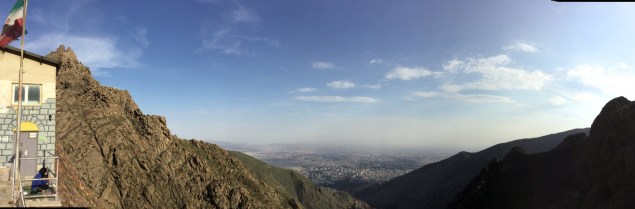
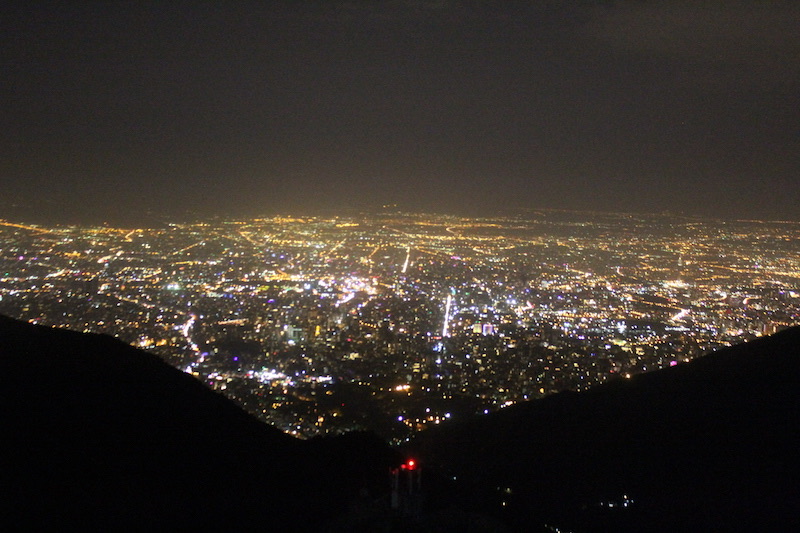
The best views of Tehran are from above; an hour drive north of the gridlocked metropolis, a few hours walking and I’m perched on a stone ledge gazing down through the clouds at the sprawling city – the contrast couldn’t be greater.
Iran fascinates me – history, politics, people – the paradox. From the old men defiantly singing under beautiful Safavid bridges to the postcard seller who fetches bread for my picnics, the cities are full of stories and characters. Yet, it’s the mountains that always call me back. Barely 24 hours after landing at Imam Khomeini International I was already plotting my path up though the fairy lights, dried fruit stalls and teahouses into another world – the Alborz Mountains.
The following morning the silence was broken by the sound of banter and laughter as I pushed open the window of the mountain shelter to breath in the cool air. On the stone terrace immediately below, a group of fit 70-year-old men were already engaged in a lively aerobics routine. A little further away a lady sat peacefully humming along to traditional music emanating from her tinny speaker.
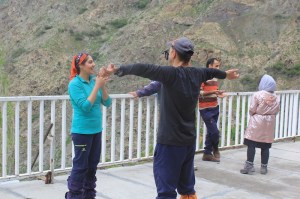
‘Thursday is for the old men, Friday is for the young people’, one of the aerobic participants panted, ‘the troubles are all down there – up here we are free to enjoy life’.
Mountains in Iran have always been associated with freedom. In pre-revolutionary days, it was one of the few places where people could escape from the watch towers of the hated SAVAK, the Shah’s secret police. More recently north Tehran and the mountains became the focus of the fated Green Revolution, sparked by Ahmadinejad’s contested 2009 election victory. The freedom slogans sprayed on the rocks may have long been painted over, but it’s still a place to escape from the Basij, Revolutionary Guards and the many other aspects of the state security apparatus.
In a similar way to your home being your private domain in Iran, there’s also an imaginary line high above the cities where things become more relaxed. Headscarves become optional. Couples hold hands. Everyone has time for each other. The old, young, religious and non-believers come to the mountains to laugh, joke, sing, reminisce – and even dance.
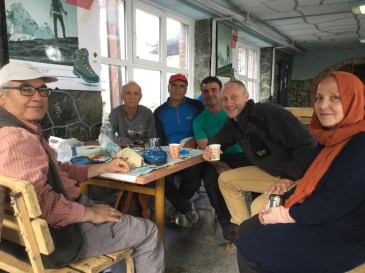 Mountain shelters, built in the time of the Shah, are dotted all over Iran’s numerous lofty ranges and serve as a focal point for the coming together of The People. They are a place for weary trekkers to shed their boots and share their experiences over seemingly endless cups of sweet, golden tea. Every time the shelter door opens it brings with it a shot of cold air – and a new arrival to the party. A ritual of respectful acknowledgement to everyone is quickly followed by offers of tea and food as each stranger becomes a friend.
The atmosphere at the shelter is liveliest in the public lounge, primarily for those passing through, rather than staying the night. Dozens of whooshing gas burners provide not only warmth – but rice, eggs and stews to the hungry trekkers.
‘Tea is available on demand’ Amir laughed as he beckoned me over to join his group. I sat down with the huddle of men and women, most old enough to remember the pre-revolutionary days. Some women wore headscarves, others had replaced them with baseball caps or bandanas. Amir continued to laugh as he explained ‘When I was 19 we had the Shah, but I didn’t drink. My brother said you have time to drink, but five years later we had the revolution – so I started drinking!’, he continued, ‘During the Shah’s time, young people did not know how to dance – now it’s forbidden everyone knows how to dance!’ His words perfectly encapsulate the spirit of defiance and humour that prevails in Iran. 
As if to prove a point a younger man turned a couple of dustbins upside down and started beating out a rhythm to accompany a booming speaker, in front of his rice pot which bubbled away on a ledge. Spontaneous dancing followed which enticed a previously stony-faced gentlemen to bust out a little cameo, to rapturous laughter and applause. Occasionally the drummer was forced to interrupt his performance to scoop a spoon of saffron rice and offer it to the ladies for approval.
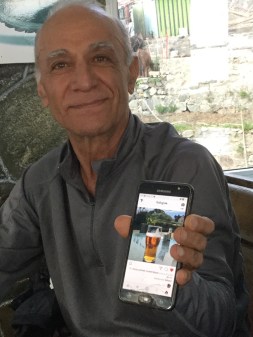 One of my new friends showed me a close up of a pint of beer on his phone. He explained that he worked working at a money print in Newcastle in the 70’s. ‘Beautiful girls too’ he chuckled, recalling a time when Iranians were free to pick up a ticket and travel anywhere in a world free of travel bans; Pre-revolution, pre-Trump.
By late evening the party had moved out to the terrace and the distinct smell of home distilleries lingered in the mountain air – time to scurry to my bunk for the good of my health.
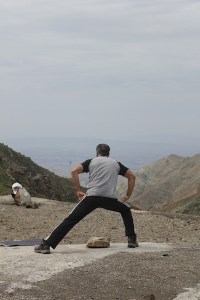 The next morning, leaving the physical and personal warmth of the shelter I took the trail up to the peak of Kolackchal. Just above the shelter, on a stone platform, a solitary man was improvising a workout. Hoisting a large rock over his head with the city below as his backdrop, it served as the perfect metaphor for his frustration.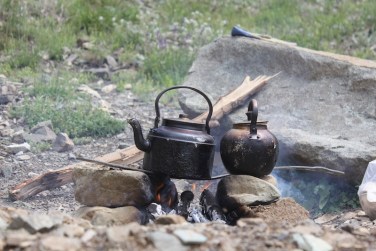
The sound of trickling water accompanied me along the path, intensifying until it manifested itself as an impressive waterfall that provided mountaineers with a spot to rest. I laid on the grass among the blackened teapots, perched skilfully on small bundles of wood. I watched as a trekker prepared eggs in a tiny pan. Noticing my attention, he scooped some creamy eggs onto fatir, a Persian sweet bread, topped it with freshly picked herbs – and delivered it to my salivating mouth.
Once again Iran, the ‘Axis of People’ had inspired and humbled me with its unabated friendliness, hospitality and generosity. From that tasty morsel delivered to my mouth by a stranger to the mobs of football fans who embraced me after Iran’s World Cup win over Morocco, it was like spending a month on a different planet. A planet where every stranger is welcomed as a friend. The sprightly 87-year-old Pennsylvanian on my tour quickly realised that the US badge on his cap was an invitation for Iranians to shake his hand, welcome him – and give him everything from tea and ice cream to an Iranian flag.
There’s no doubting the concern about the stumbling nuclear deal and biting sanctions; I was party to a hilarious scene where a group of my Iranian friends sat around debating what they planned to do to escape when war came; Iranians have a subtle brand of humour that constantly pokes fun at the establishment.
There’s also a dogged spirit that has developed through 40 years of sanctions and political hostility from the west (a third generation of Iranians who have never known life without sanctions is just being born).
As one of my shopkeeper friends in Shiraz said ‘Why should we worry? – we’ve seen off five Trumps already’
He makes a very good point.
 The Lonely Chopstick